The Four People Every Leader Needs
Leadership can be both crowded and lonely. As leaders, we spend our days surrounded by colleagues, teams, and communities, and still have very few people with whom we can be vulnerable. This includes sharing our thinking, navigating uncertainty, or elevating questions that are top of mind.
The higher we rise in leadership, the more intentional we must become about the people we allow close enough to influence us. Not everyone in our circle should and will serve the same purpose. We need people who help us see ourselves clearly, imagine beyond our current reality, recover our confidence, and test our thinking.
In The Four Pivots: Reimagining Justice, Reimagining Ourselves, Shawn A. Ginwright challenges us to move from lens to mirror and from problem to possibility. The first shift calls us to look inward and examine who we are becoming. The second asks us to move beyond the limitations of what is and cultivate a vision of what could be. This leadership-circle framework applies those ideas relationally: sometimes other people help us do the reflective and imaginative work that is difficult to do alone.
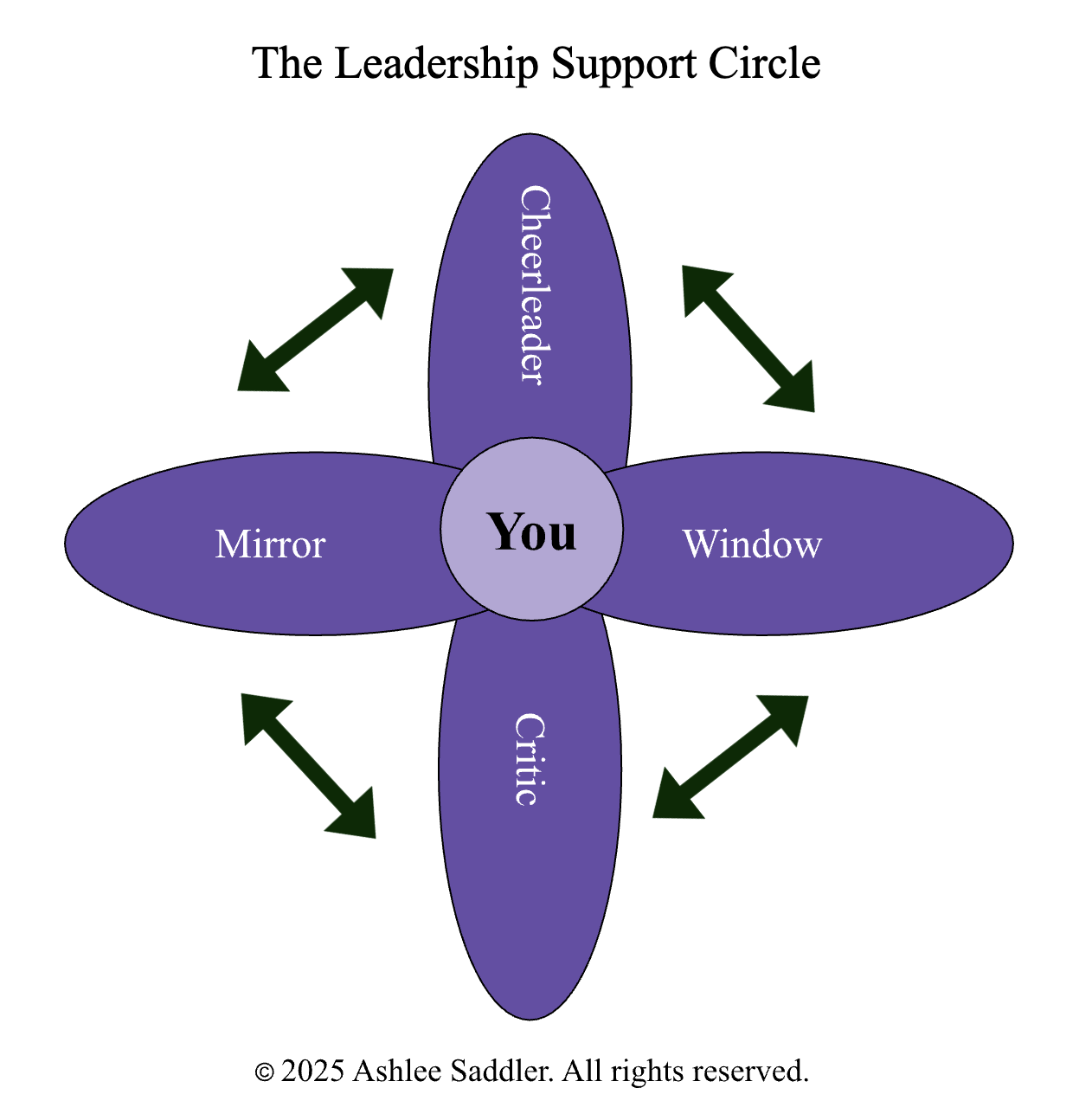
I would argue that every leader needs four essential forms of support: a mirror, a window, a cheerleader, and a critic. These do not always have to be four different people, but all four functions should be present in a healthy leadership circle.
The Mirror: Who Helps You See Yourself Clearly?
A mirror reflects more than the decisions we make; it helps us examine the person we are becoming while making them.
Ginwright (2022) describes mirror work as the movement from focusing exclusively on external problems to engaging in honest internal reflection. For leaders, this means asking not only, “What needs to change?” but also, “What might I need to confront, learn, heal, or change within myself?”
The mirror in your circle is someone who helps you recognize the alignment, or misalignment, between your intentions, actions, and impact. This person notices your patterns. They can tell you when your leadership reflects your stated values and when pressure, fear, ego, or exhaustion may be pulling you away from them.
A trusted mirror might ask:
What is driving this decision?
How might others be experiencing your leadership right now?
Is this response consistent with your values?
What pattern do you notice in the way you are approaching this challenge?
It is important to note that a mirror does not exist to shame us. A good mirror offers truth with care. Their honesty invites us into deeper self-awareness so we can lead with greater integrity.
The Window: Who Helps You See What Is Possible?
While a mirror helps us look inward, a window expands our view.
Leaders spend so much time responding to immediate needs that urgency can slowly narrow the imagination. School leaders are constantly combing through data to understand gaps. When every conversation centers on what is broken, behind, under-resourced, or not working, it becomes difficult to envision anything beyond the current conditions.
Ginwright’s (2022) pivot from problem to possibility reminds us that transformation requires more than diagnosing and fixing problems. We must also develop the capacity to imagine a future that does not yet exist.
The window in your circle helps you lift your eyes from the immediate challenge and look toward the horizon. This person brings a different perspective, sees emerging opportunities, and stretches your thinking beyond familiar approaches. They do not ignore reality; they refuse to let today’s reality become the limit of tomorrow’s possibility.
A window might ask:
What could become possible if this barrier no longer existed?
What are you seeing on the horizon that requires you to prepare now?
Whose perspective is missing from your vision?
The miracle question: If you were not constrained by the current model, what might you create?
Vision is not fantasy. It is disciplined imagination and the ability to see beyond what is while building toward what could be.
The Cheerleader: Who Helps You Recover Your Voice?
Even the strongest leaders experience moments when their confidence wanes. A difficult season, a public setback, persistent resistance, or an environment that repeatedly questions our belonging can cause us to doubt what we know and minimize what we bring.
A cheerleader is not someone who offers empty praise or agrees with every decision. They are someone who remembers your strength when you temporarily lose sight of it. They remind you of the evidence: what you have overcome, what you have learned, whom you have helped, and how your leadership has made a difference.
This support is especially important when we become weighed down by an imposter system, including the messages, norms, and conditions that lead capable people to question whether they belong. A trusted cheerleader does not simply say, “You can do it.” They help you reconnect with why you began, what you know to be true, and the voice that was yours before doubt became louder than purpose.
The best cheerleaders do not speak for us. They help us find the strength to speak for ourselves again.
The Critic: Who Is Willing to Challenge You?
Support without challenge can leave a leader affirmed but unexamined. Every leader also needs someone who is willing to test the strength of an idea, surface what has been overlooked, and name the risks that enthusiasm may hide.
A healthy critic is not a cynic. Cynics search for reasons an idea cannot work; constructive critics help make the idea stronger. They ask about evidence, assumptions, tradeoffs, timing, and unintended consequences.
A critic might ask:
What assumption are you making that may not be true?
What evidence supports this direction?
Who benefits from this decision, and who may carry its burden?
What could go wrong, and how will you prepare for it?
The critic and the mirror are not the same. The mirror helps us examine the leader; the critic helps us interrogate the idea. Both require trust. The right critic is committed to our growth and the success of the work.
Build Your Circle With Intention
Each of these people offers something essential. The mirror cultivates self-awareness. The window expands possibility. The cheerleader restores courage. The critic strengthens judgment.
Without balance, however, even a good form of support can become incomplete. A cheerleader without a critic may reinforce poor decisions. A critic without a cheerleader may gradually erode confidence. A window without a mirror may inspire a vision disconnected from the leader we need to become. A mirror without a window may keep us reflecting without ever moving forward.
Take a moment to consider your own circle:
Who tells you the truth about who you are becoming?
Who expands your view of what is possible?
Who helps you recover your voice when doubt grows loud?
Who challenges your thinking and keeps you grounded?
Which voice is currently missing?
Then consider one more question: Whose mirror, window, cheerleader, or critic are you?
Leading well requires more than individual talent. It requires a relational ecosystem strong enough to hold our growth, vision, vulnerability, and accountability. Living well requires remembering that we were never meant to carry the full weight of leadership alone.
Choose your circle with intention. Give each person permission to play their role. And remain open to the truth, possibility, courage, and wisdom they bring.
The quality of our leadership is shaped not only by the voice within us, but also by the voices we allow around us.
Reference
Ginwright, S. A. (2022). The four pivots: Reimagining justice, reimagining ourselves. North Atlantic Books.
https://ashlees-newsletter-c84a34.beehiiv.com/p/who-is-in-your-leadership-circle