In October, we examined the four types of people every leader needs in their leadership journey: a mirror, a window, a cheerleader, and a critic. Each offers an essential form of support, helping us see ourselves clearly, imagine what is possible, recover our confidence and strengthen our thinking. These roles may be filled by different people or overlap within a few trusted relationships. What matters is that we intentionally make room for each.
In this article, we begin a deeper exploration of these roles, starting with the mirror. This is the person who helps us examine who we are becoming as we lead. It is one thing to surround ourselves with people who support our growth. It is another to give someone permission to tell us what that growth may require.
As a principal, I surrounded myself with mirrors without realizing it. Upon accepting the principalship of a P-8 building, I needed to make some hires. There were teachers and staff in my currently building (where I was serving as an assistant principal) who wanted to follow me to the new building. Many of these individuals became my mirror. Let’s dig into how they unknowingly became mirrors for me in my leadership.
I didn’t hire everyone who asked to move with me to the new building, but the ones I did hire had specific strengths and demonstrated skills and competencies as a teacher/educator. Additionally, we inevitably had a strong and positive relationship. The relational piece was the impetus for them becoming a mirror. Because there was mutual trust, I asked those who joined me in the new building to be my eyes and ears and serve as a thought partner as decisions were made, even if they didn’t have a formal leadership role or title in the building. Providing these few staff members with being my eyes and ears also meant that we had a relationship where they could be open and honest with me. They were my mirrors.
As a principal, I had a forest and trees approach to supporting the building. I needed to see the big picture and the fine, minute details. However, there were still aspects that I couldn’t always see. As leaders, we spend considerable time investigating what is happening around us and asking what needs to change around us. The mirror invites us to consider a more personal question: What might I need to see more clearly about myself?
Part 1: The Mirror
The Courage to See Yourself Clearly
There are questions we ask readily as leaders. What needs to change? Why are we not making progress? What support does the team need? We examine decisions, study outcomes, and look for the conditions that may be getting in the way.
Then there are the questions that ask something more of us. What is it like to be led by me? What happens to my leadership when I feel challenged? Am I creating the conditions I say I believe in? These questions can be difficult because they bring us personally into the examination. A level of vulnerability exists in these questions. They ask us to consider how our ways of responding may be shaping the very conditions we hope to change.
In my leadership-circle framework The Leadership Support Circle (Figure1) this is the work of the mirror: the person or people who help us see ourselves more clearly and examine who we are becoming while leading others.
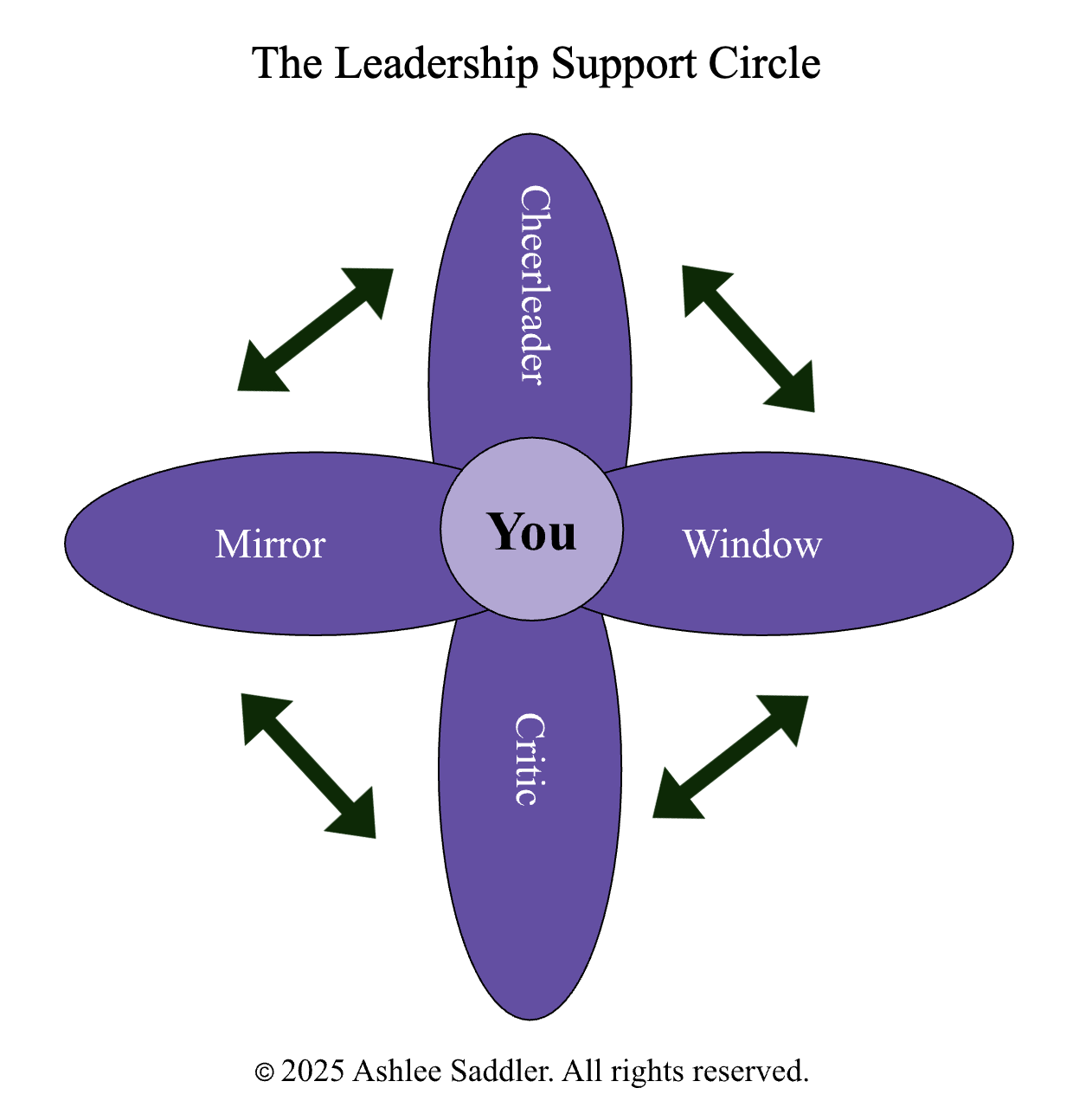
Figure 1
Turning the Reflection Inward
In The Four Pivots: Reimagining Justice, Reimagining Ourselves, Shawn A. Ginwright (2022) identifies a shift in awareness from lens to mirror. His work places personal reflection within the broader work of social and systemic change. I draw on that pivot here to consider a relational question: Who helps us examine our own participation in the conditions we want to transform?
Leaders are often expected to diagnose what is happening around them. We learn to recognize gaps, identify barriers, and determine what others need to do differently. Turning that attention inward requires us to consider our assumptions, our habits, and the experiences that influence how we interpret a situation.
A leader may recognize that a team is reluctant to contribute without noticing how quickly they respond to an unfinished idea. Another may describe a colleague as resistant without examining whether there has been meaningful room to influence the direction. We can name a problem accurately and still have more to learn about our role in it. A trusted mirror helps us stay with that possibility long enough to learn from it.
When Intention and Impact Diverge
Most leaders can explain what they intended. We intended to provide clarity. We intended to protect the team. We intended to communicate urgency because the work mattered.
Yet the people receiving our leadership may experience something different. What we understand as clarity may leave little room for questions. Our effort to protect a team may limit its access to information. Our urgency may make every concern feel like an interruption.
Consider a leader who regularly invites input but begins defending the proposed direction as soon as someone raises a concern. The invitation may be sincere. Over time, however, colleagues may decide that the safest contribution is agreement. When the leader later wonders why no one speaks up, a mirror can help connect that silence to a pattern the leader has not recognized.
That conversation requires specificity. “You do not listen” gives us little to examine and much to defend against. “You asked for concerns, but you responded before two people had finished speaking” offers something we can revisit. It creates an opportunity to ask what happened, what others experienced, and what we might do differently.
Good intentions matter. They also need to be considered alongside the experiences of the people affected by our actions.
Reflection That Leads to Responsibility
Honest reflection can be uncomfortable. Discomfort alone, however, does not tell us whether we are learning. There is a difference between examining a behavior and making a sweeping judgment about our worth. “I interrupted that conversation and need to repair it” identifies an action and a responsibility. “I am a terrible leader” can leave us absorbed in judging ourselves, with little attention left for the person affected.
A good mirror helps keep the conversation grounded in facts and behaviors. They can recognize our strengths while being direct about a behavior that needs to change. When facts are coupled with care, the conversation allows for honesty, and honesty keeps care connected to accountability.
Reflection becomes useful when it shifts our processes and our behaviors. This may mean revisiting a conversation or acknowledging an impact we did not intend. As leaders, it can be challenging to make reflective statements aloud, but consider the amount of strength required to have this level of honesty and what is modeled to the entire staff.
Giving Someone Permission to Be Your Mirror
I shared earlier the individuals who became my mirror. I didn’t explicitly say to anyone, “You are now knighted as my mirror.” During my principalship, I also didn’t have the language of this framework around a leadership circle. However, the individuals selected were those who I trusted and valued their thoughts, perspective, and opinions. The learning for me prompted the creation of this framework and for current leaders to be more intentional about their mirror.
Consider selecting a person who is on staff and observes your leadership regularly. This person also needs to be comfortable having conversation with depth. This person should be able to recognize your strengths and question your interpretation. Familiarity alone does not guarantee that someone can offer the perspective you need.
I covertly selected my mirrors but you may want to be more overt. A more formalized invitation may include the following conversation: “I want to better understand how others experience my leadership, especially when I am under pressure. Would you be willing to share patterns you notice, including moments when my actions do not reflect my stated values? Specific examples would help me. I will work on listening before I explain.”
Consider when to have the follow up conversation. A private conversation after a meeting may be useful. Also, a brief monthly check-in around one practice you are trying to strengthen. If this person reports to you, acknowledge the power difference and provide other ways to offer feedback as well.
When feedback comes, ask for an example and check your understanding. Give yourself time to consider it. You can examine a perspective thoughtfully without accepting every interpretation as a complete account of who you are. Consider returning to the person with what you learned and how you plan to implement the learning.
The Leadership Mirror Audit
Consider using one or more of the questions below to examine one recent leadership experience. Begin with a specific interaction so your reflection stays connected to what you actually said and behaviors.
1. What patterns keep appearing in my leadership? Where have I received similar feedback or encountered a familiar outcome?
2. When am I most aligned with my values?
3. What might others be experiencing that I cannot currently see? Whose perspective would help me understand more?
An Invitation to See More Clearly
Leadership asks us to make decisions that affect other people. That responsibility includes remaining willing to learn how they experience us. The mirror in our circle helps us sustain that willingness. They can hold our intentions with care while asking us to examine our impact. Through that relationship, we have an opportunity to bring our actions into closer alignment with the leader we want to become.
This week, ask one trusted person: “What is something you see in my leadership that I may not see clearly myself?”
Listen long enough to understand. Then decide what you will do with what you learn.
Reference
Ginwright, S. A. (2022). The four pivots: Reimagining justice, reimagining ourselves. North Atlantic Books.